
The article From Bazaar to Street: Investigating the dynamic of Tehran’s urban growth in the pre-modern and early modern times (Afshar Bakeshloo and Akbari, 2024) explores the history of Tehran’s urban planning through a combination of theoretical discourse, historical analysis, and Space Syntax methodology. It examines two major urban interventions: one during the Qajar era and another in the Pahlavi period, comparing their structural impacts and consequences in shaping the city’s form.
Afshar Bakeshloo and Akbari argue that these two interventions yielded distinct outcomes. The Qajar-era intervention preserved Tehran’s traditional structure, maintaining the bazaar’s centrality while incorporating new streets. Conversely, the Pahlavi intervention shifted the city’s organizing principle from the bazaar to streets, reorienting its urban framework. This conclusion aligns with insights from Two Approaches to the Development of Tehran(Shirazian, 2013), another influential study in urban history, although the current article does not explicitly cite it. Along its insightful use of Space Syntax, the article represents a highly valuable effort in advancing the understanding of urban history in Iran which can serve as an excellent reference for broader historical studies, particularly in terms of methodology. This critique focuses specifically on the first section of the article, From Bazaar to Street, which examines the transformation of Tehran during the Naserid era. The article could benefit from improved historical rigor in its narrative, assumptions, and conclusions. A more precise selection of analytical cases and interpretation of results could enhance its findings. Below is a detailed critique of key assumptions and arguments.
1. Historical Assumptions and Analysis
1.1. Top-Down Planning vs. Formalizing Existing Growth
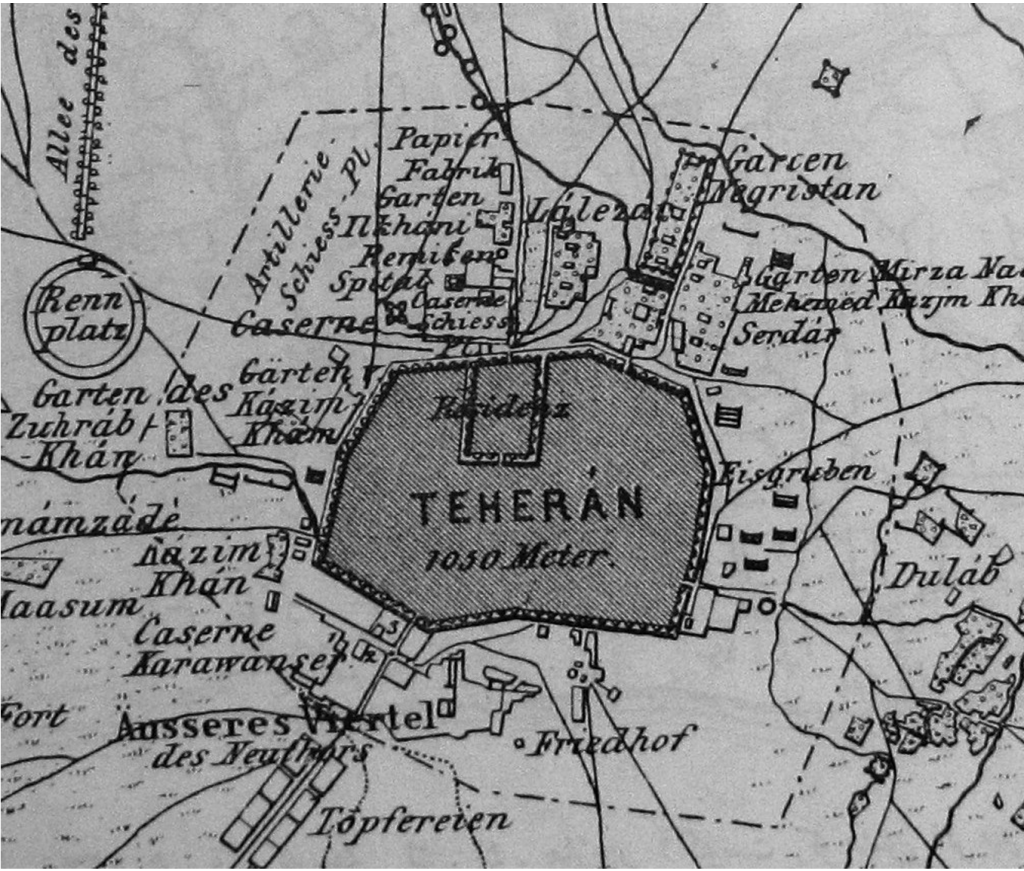
The article posits that Naser al-Din Shah’s intervention was a top-down initiative imposed on an undeveloped area outside Tehran’s original walls, based on a pre-intervention map which excluded outside the walls. However, earlier maps and evidence (Najafi, 2009, p135, ) suggest that areas beyond the city walls had already experienced organic growth and had a dense structure. This growth, driven by private ownership and natural expansion, limited the Shah’s ability to enforce a fully top-down plan. Instead, the intervention formalized existing expansion by reconstructing the walls to accommodate the city’s growth. This recontextualizes the Qajar plan, challenging its comparison to the more deliberate urban interventions of the Safavid or Pahlavi periods.
1.2. Neglecting Southern Connections
The article emphasizes six northern streets as central to the Qajar intervention, yet it overlooks southern connectors like Gomrok and Shah Abdol-Azim streets. These routes also linked old and new parts of Tehran, complicating the narrative that urban development was solely centered on northern expansion.
1.3. Innovation Misattributed
The article identifies the creation of six streets as the hallmark of Naser al-Din Shah’s urban planning, but as mentioned before, historical records suggest these streets existed before the demolition of the city walls. The actual innovation lay in the deliberate construction of Toopkhaneh Square, which organized surrounding streets and symbolized royal authority. This focus on squares, rather than streets, reflects a deeper tradition in Iranian urban planning, meriting further exploration and comparison with Safavid-era squares.
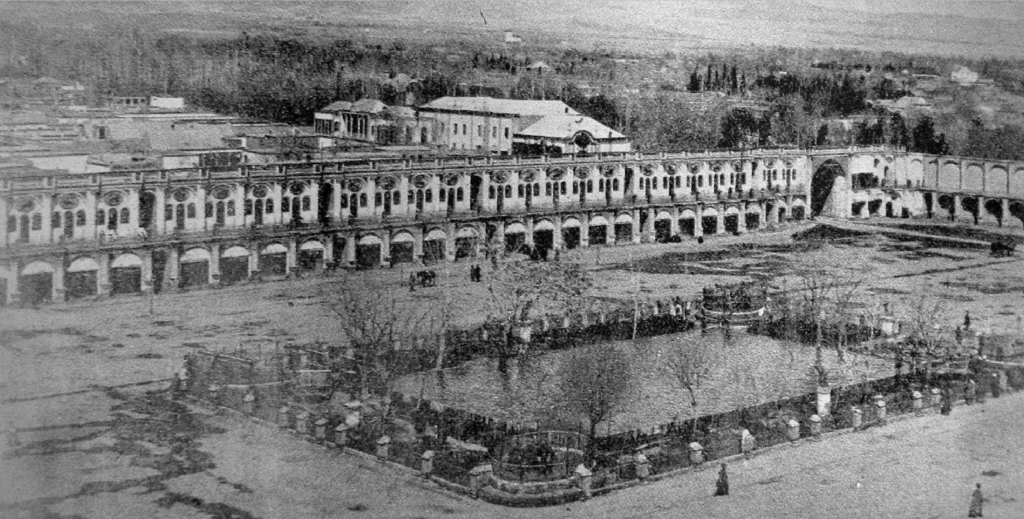
Moreover, the narrative assumes that urban development traditionally revolved around the bazaar. While accurate for bottom-up growth, this was not universally true. Even during the Qajar period, alongside the Shah’s interventions, the bazaar expanded, and spaces like Amin Sultan Square in the south played vital roles in the urban economy. The assumption that Safavid interventions were entirely market-driven also warrants reconsideration. Karimi and Motamed’s(2003) analysis of Isfahan identifies four main components of Safavid development—Naqsh-e Jahan Square, Chahar Bagh, new neighborhoods, and water networks—with the bazaar occupying only a limited role in such ambitious project.
2. Questioning the “Tehran Style” Concept
The article adopts Habibi’s(1994) concept of a hybrid “Tehran Style,” blending Iranian and Western urban principles. While intriguing, this notion requires further clarification.
2.1. Urban Design vs. Architecture
Although Qajar-era architecture reflected Western influences, such as in Tekyeh Dowlat, these influences did not significantly shape urban design. The cautious formalization of pre-existing structures contrasts sharply with the innovative urban planning seen in Safavid Isfahan.
2.2. Western Streets or Eastern Avenues?
The article associates Qajar streets with Western design, but these streets, as Habibi himself notes, initially had an Eastern aesthetic, featuring gardens and water channels reminiscent of Safavid Chahar Bagh rather than Western boulevards. (Habibi and Ahari, 2008, p12) Over time, commercial pressures and Western economic influences transformed their function, integrating new types of commerce and trade. Thus, this evolution was a socio-economic byproduct rather than a deliberate royal design.1 In fact, the fact that these streets emerged naturally as a result of the city’s growth and needs, rather than through top-down intervention, allowed them to establish a new center of gravity without undermining the bazaar’s centrality. Clarifying the definition of “Western streets” within this context and distinguishing between design intent and emergent socio-economic shifts would refine the argument.
Conclusion
The article From Bazaar to Street offers a valuable analysis of Tehran’s urban development but could be strengthened by a more nuanced historical approach. It overemphasizes the novelty of Qajar streets while underexploring the organic and historical continuities shaping urban change. Furthermore, the “Tehran Style” concept requires deeper scrutiny, distinguishing design intentions from subsequent socio-economic transformations.
References
Karimi, K. and Motamed, N., 2003. The Tale of Two Cities: Urban Planning of the City Isfahan in the Past and Present. Proceedings of the 4th International Space Syntax Symposium, London.
Ahari, Z. and Habibi, S.M., 2008. Lalehzar: From Garden to Avenue—Formation of a European-style Street During Naser al-Din Shah’s Era. Fine Arts, 34(0), pp.5–15.
Shirazian, R., 2013. Two Approaches to the Expansion of Tehran. Architecture and Culture, (52), Summer.
Afshar Bakeshloo, F. and Akbari, B., 2024. From Bazaar to Street: Investigating the dynamic of Tehran’s urban growth in the pre-modern and early modern times. Proceedings of the 14th International Space Syntax Symposium, Nikosia.
Habibi, S.M., 1994. The First Echo of Modernity in Iran. Goftogu, (3), pp.138–152.
Najafi, M., 2009. Analysis and recognition of Toopkhaneh Square of Tehran in Naseri Era. Master’s thesis. Shahid Beheshti University, Faculty of Architecture and Urban Planning.